Saturday, March 14, 2015

#16 March 15: God Hardens Pharaoh's Heart

Exodus 5-7


Moses and Aaron came to speak to the Israelites in Egypt. They told the people all that God had said to Moses. They performed miracles before the people and the people were convinced.

Then Moses and Aaron came before Pharaoh and said to him, "The God of the Hebrews has appeared to us. Please let us go a distance of three days into the wilderness to worship our God."

But Pharaoh answered, "You are distracting the people from their work!" Pharaoh ordered the taskmasters, "You will no longer provide the slaves with straw to make their bricks. From now on they will have to gather straw for themselves. But do not reduce the daily amount required. They are lazy. That is why they want to stop working and go sacrifice to their God. Let them work harder so they will not have time to listen to such false promises."

So the people had to work even harder. And when they did not make the required amount of bricks, the taskmasters beat them. Then the Israelite guards came to Moses and Aaron and said to them, "May God punish you! You have put a sword in the hands of the Egyptians to kill us."

Moses turned to God and said, "Why have You brought harm to Your people? And why did you send me? Ever since I came to Pharaoh to speak in Your name, he has dealt even worse with them. And still You have not freed Your people."

God said to Moses, "You will soon see what I will do to pharaoh. He will let the people go because of a power greater than his. In fact, he will drive them from his land. Go to Pharaoh and act as God before him, and your brother, Aaron, will serve as your prophet. Tell Pharaoh to let the Israelites leave his land. But I will harden Pharaoh's heart so that he will refuse, and then I will show Egypt that I am God. I will stretch out my hand and bring the Israelites out of their midst."

~

With a partner or on a sheet of paper, respond to the following questions:

1. Moses and Aaron are sent by God to Egypt to lead the Israelites out of slavery. But first they must convince the Israelite people that God actually sent them to do so. How do Moses and Aaron convince the people? Why is this necessary?

2. When Moses and Aaron first ask that the Israelites be released from their work to leave Egypt and serve God in the wilderness, what does Pharaoh do to the people? 

3. Why do the Israelite guards curse Moses and Aaron, saying, "May God punish you! You have put a sword in the hands of the Egyptians to kill us"? 

Instead of just freeing the Israelites, God decides to draw out the process by hardening Pharaoh's heart. Even after nine plagues sent to strike pharaoh and the Egyptians, Pharaoh's heart is hardened and refuses to let the Israelites go. It is not until the tenth and final plague (when God kills the first born sons of every Egyptian household) that Pharaoh finally let's the people go. 

What do you think it means to harden someone's heart?

But I will harden Pharaoh's heart so that he will refuse, and then I will show Egypt that I am God.  -- According to Rashi, God chooses to harden Pharaoh's heart because God will then have the opportunity to show how powerful God is -- by sending ten terrible plagues. God wants to show the Israelites what will happen if they behave like the Egyptians. This, Rashi says, is God's way: God punishes sinful nations so that God's people, the Israelites, will see this punishment, become fearful, and choose to behave differently. 

Why do you think God chooses to harden Pharaoh's heart? Is this fair of God to do? Why or why not?Do you agree with Rashi's interpretation? Why or why not? (Post your response below in the comment section.)

Sunday, March 8, 2015

Moses Leaves Egypt

A Stranger in a Foreign Land
Exodus 2:11-22

Some time later, when Moses was grown up, he went out among his people and saw how hard they worked. He saw an Egyptian beating a Hebrew slave. He looked around, and seeing that no one was close by, he struck the Egyptian dead and buried his body in the sand.
The next day when Moses went out among the Hebrew slaves, he came upon two of them fighting.
Moses said to the one who was in the wrong, “Why are you beating your fellow Hebrew?”
The man answered, “Who made you lord and master over us? Do you plan to kill me like you killed the Egyptian?”
Then Moses was afraid. He thought, “Surely everyone must know!”
When Pharaoh learned what Moses has done, he tried to have Moses killed. So Moses ran away to the land of Midian. He came to a well and rested there.
No Yitro, the priest of Midian, had seven daughters. They came to the well and filled the troughs to water their father’s flock of sheep. But other shepherds came and drove them away. Mose came to their defense, and he watered their flock.
When the seven sisters returned home, their father asked them, “Why are you home so early?”
They answered, “An Egyptian saved us from the other shepherds, and even watered our flock.”
“Where is this man?” he asked his daughters. “Why did you leave him there? Bring him home so her can share bread with us.”
Moses agreed to stay with Yitro and his family. Yitro gave Moses his daughter Tzipporah as his wife. She gave birth to a son, whom Moses named Gershom, saying, “I have been a stranger - ger - in a foreign land.”
~
On a sheet of paper or with a partner, respond to the following questions:
  1. Based on the story, is Moses an Egyptian or a Hebrew?
  2. Moses kills a man in this story. You be the judge - did Moses do right or wrong? Explain your answer.
  3. Why does Moses run away from Egypt?
  4. Based on all of Moses’ actions in this story, what kind of man is he? How would you describe his personality?

Respond to the following question on our blog:

Why do you think Moses calls himself a “stranger in a foreign land?” Which land is he talking about? How is he a stranger?


Saturday, February 28, 2015

#14 March 1 - Baby Moses

The Birth of Moses
Exodus 2:1-10


Amram, an Israelite from the House of Levi, married Yocheved, also from the House of Levi. And Yocheved gave birth to a son. When she saw how good (tov) he was, she hid the baby for three months. When she could no longer hide him, she took a small basket made of reeds and placed the child in it. Then she set it afloat among the reeds along the banks of the Nile. Miriam, the baby's sister, watched from a distance to see what would happen to the child.


Pharaoh's daughter came down to bathe in the Nile. She saw the basket among the reeds and sent her slave girl to bring it to her. When she opened it, she found a baby boy, crying. She took pity on him and said, "This must be one of the Hebrew babies."


Then Miriam said to Pharaoh's daughter, "Should I go and fetch you a Hebrew woman to nurse the child?"


"Yes, go, " Pharaoh's daughter answered.


Miriam brought Yocheved, the baby's mother.


Pharaoh's daughter said to her, "Take this child, nurse him, and I will pay you."


So Yocheved took her own child and nursed him. And when he was old enough, she brought him to Pharaoh's daughter, who adopted him as her own son.


Pharaoh's daughter named him Moses, Moshe, because, she said, "I took him out - mee-shee-tee-hu - of the water."


~
With a partner or on a sheet of paper, answer the following questions:
  • Just before this part of the story, the Pharaoh made all Hebrews work as his slaves and then made a law that all Hebrew baby boys born must be thrown into the Nile river. He did this because he was afraid that the Hebrew population would get so big that they would become more powerful than the Egyptians. Does Yocheved, a Hebrew woman, follow the Pharaoh's law? Explain your answer


  • This is the moment in the Torah when we first meet Miriam, Moses’ older sister. Based on what she does in this story, how would describe Miriam?


  • How is Moses saved?


  • Why is the boy named Moses (Moshe)?


  • In the future, when Moses is a man, God will call on him to lead the Hebrew slaves out of Egypt so they can be free. The final moment of their escape from Egypt and Pharaoh is when the Hebrews enter the Reed Sea and God causes the waters to split so they can walk through on dry land to safety. Can you see a connection between how Moses is saved as a baby and how the Hebrews are saved? Explain your answer in the comment box below on the blog.


Read the following commentary and answer the related questions:


"When she saw how good (tov) he was" - What does it mean, he was good? When Moses was born the entire house became filled with light. 

This comment comes from Rashi. He thinks it is obvious that all mothers see their newborn babies as good - so what he wants to know is what makes Moses so special? What does "good" mean here? Rashi notices that the same phrase "that he was good" is used to describe the light God creates on the first day of creation. "And God saw that the light was tov - good." So when this story says that Yocheved saw that Moses was good, Rashi thinks it means that he filled her home with light.

  • How does this comment explain why Yocheved hid her baby?
  • How does this comment explain why Moses is special?

Tuesday, February 17, 2015

What's Havdalah?

A Havdalah Primer for you and your family....

What's Havdalah?
On Saturday night there is a ceremony that ends Shabbat and begins the new week. We began Shabbat by lighting candles and blessing wine (or grape juice). And we end Shabbat when we put a candle out by dipping it in wine. The name of this ceremony is havdalah, which means to make a distinction. Havdalah marks the difference between Shabbat and the rest of the week. 

Why do you think making this distinction is so important?

How do we do Havdalah?
Like most Jewish ceremonies, the havdalah ritual is very simple. We recite (or sing) four blessings: over a cup of wine (or grape juice), over spices, over fire, and over the moment itself. As we recite each blessing we bring our attention to whatever we are blessing: we raise the wine cup, smell the spices, hold our fingers up to the light. After we have recited the final blessing, we take a sip of the wine and extinguish the havdalah candle in the wine. The hiss of the candle going out tells you Shabbat has ended and the week has begun. Often we celebrate this moment by singing songs about Elijah, a prophet who, we are told, will bring news of everlasting world peace. 

Why do you think the havdalah ceremony has us use all of our senses?

But what does it mean?
Havdalah asks us to make distinctions between what is holy (like Shabbat) and what is ordinary (like the weekdays). When we keep our eye out for distinctions like this, we actually pay better attention to what we are experiencing in life.

What is the difference between a holy thing and an ordinary thing?

Homework before Havdalah with FLP
Become a havdalah expert! Practice reciting each of the four blessings with your family:
The Blessing over Wine or Grape Juice
בָּרוּךְ אַתָּה יְיָ, אֱלֹהֵֽינוּ מֶֽלֶךְ הָעוֹלָם, בּוֹרֵא פְּרִי הַגָּֽפֶן.
Baruch atah, Adonai, Elohaynu melech ha’olam, boray pri hagafen.
Blessed are You, God, our Lord, King of the universe, Creator of the fruit of the vine.
The Blessing over Spices
בָּרוּךְ אַתָּה יְיָ, אֱלֹהֵֽינוּ מֶֽלֶךְ הָעוֹלָם, בּוֹרֵא מִינֵי בְשָׂמִים.
Baruch atah, Adonai, Elohaynu melech ha’olam, boray minay vesamim.
Blessed are You, God, our Lord, King of the universe, Creator of the different spices.
The Blessing over the Candle
בָּרוּךְ אַתָּה יְיָ, אֱלֹהֵֽינוּ מֶֽלֶךְ הָעוֹלָם, בּוֹרֵא מְאוֹרֵי הָאֵשׁ.
Baruch atah, Adonai, Elohaynu melech ha’olam, boray me’oray ha’aysh.
Blessed are You, God, our Lord, King of the universe, Creator of the fire’s lights.
The Blessing over Havdalah
בָּרוּךְ אַתָּה יְיָ, אֱלֹהֵֽינוּ מֶֽלֶךְ הָעוֹלָם, הַמַּבְדִיל בֵּין קֹֽדֶשׁ לְחוֹל, בֵּין אוֹר לְחֹֽשֶׁךְ, בֵּין יִשְׂרָאֵל לָעַמִּים, בֵּין יוֹם הַשְּׁבִיעִי לְשֵֽׁשֶׁת יְמֵי הַמַּעֲשֶׂה. בָּרוּךְ אַתָּה יְיָ, הַמַּבְדִיל בֵּין קֹֽדֶשׁ לְחוֹל.
Baruch atah, Adonai, Elohaynu melech ha’olam, hamavdil bayn kodesh lechol bayn or lechoshech bayn Yisrael la’amim bayn yom hashevi’i leshayshet yemay hama’aseh. Baruch atah, Adonai, hamavdil bayn kodesh lechol.
Blessed are You, God, our Lord, King of the universe, who separates between the holy and the profane; between the light and dark; between Israel and the other nations; between the seventh day and the six days of the week. Blessed are You, God, who separates between the holy and the profane.


#13 February 22 - Joseph in Egypt

Joseph in Egypt
Adapted from Genesis 39:1-41:57

The caravan that had bought Joseph as a slave continued on its way. When it reached Egypt, the traders sold Joseph to the captain of the pharaoh’s guards, Potiphar.
Potiphar liked Joseph and made him the head of his household. At first his wife also liked Joseph but then she became angry when he wouldn’t let her boss him around the way she liked. So, she told lies about him and, before he knew it, Joseph was thrown into jail.
While in jail, he met two of the pharaoh’s servants, the wine server and the baker. One night the wine server and the baker each had a dream. They told Joseph their dreams.
“I dreamt that there was a vine with three branches,” said the wine server, “and it was growing grapes. Then I made the grapes into wine and poured it into the Pharaoh’s cup.”
“God has given me the ability to understand dreams,” Joseph told the wine server, “and I think I know what your dream means.” Joseph then told the wine server that in three days the king would give him back his job.
The baker liked that explanation! He was anxious to hear what good things Joseph would tell him. “I dreamt that I had three baskets of bread on my head,” he said. “Then a bird came and ate some bread right out of the basket.”
Joseph told him what the dream meant. “In three days Pharaoh will take you out of prison too but you will not go back to your job. Pharaoh will kill you.” Sure enough, three days later, Pharaoh gave his wine server back his job. But he did not forgive the baker for what he had done.
“Don’t forget to tell the king who told you what your dream meant,” Joseph reminded the wine server as he was leaving jail.
“I most certainly will,” the wine server assured him.
But of course, he completely forgot about Joseph.
~
Two years later, Pharaoh woke up in the middle of the night, very troubled. He called for all his advisors and magicians to come at once. “I have had two very disturbing dreams and I need someone to tell me what they mean,” Pharaoh announced.
But no one could explain to Pharaoh what his dreams meant. Suddenly, the wine server remembered the Hebrew, Joseph, who had explained his dream. “I know someone who can interpret your dream,” he told the king. “Only, he’s in jail right now.”
The king ordered his guards to bring Joseph to him.
When Joseph appeared, he told Pharaoh, “Your Excellency, please tell me your dreams. I will pray to my God to tell me what your dreams mean.” So Pharaoh told Joseph his dreams.
“I was standing at the edge of the river and I could see seven fat cows feeding on the grass. Suddenly, seven very scrawny sick cows appeared and ate up the fat ones. After they ate the fat cows, the scrawny cows looked just as skinny and sickly as before!”
“Then I woke up from my dream. But I fell asleep again and had another dream,” continued Pharaoh. “In this dream, I saw seven full ears of corn. And then seven dried out, thin ears of corn appeared, and swallowed up the full ones. After they ate the full ones, the thin ears of corn looked just as dried out as before!”
Pharaoh turned to Joseph. “I told these dreams to all of my advisors and magicians, and no one could explain them to me.”
“Both dreams mean the same thing,” Joseph told Pharaoh, “There will be seven years of plenty in Egypt. But then there will be seven years of famine, when nothing will grow.”
“What should we do?” asked the king.
“Pharaoh should find a wise man and set him over the land of Egypt,” Joseph advised. “This man will be in charge of storing food during the good years, so there will be enough left for the hard years.”
Pharaoh heard Joseph’s words and realized he was right. “We will not find a man who is wiser than you are,” Pharaoh said to Joseph. “You will be in charge of my house and you will be second only to me.” Pharaoh made Joseph his second in command of all Egypt. Soon after, Joseph married and had two sons, Menashe and Ephraim.
~
Steps for Completing this Torah Hangout:

  1. Read the story above.
  2. With a partner or on a sheet of paper, discuss the following questions:
    1. How would you describe Joseph’s personality? Compare Joseph’s character in this story to his character when he was still at home with his father and brothers.
    2. How does Joseph go from being a slave to being the Pharaoh’s second in command?
    3. According to Joseph, how is he able to understand the meaning of dreams?
    4. When we learned about Joseph as a young man still living with his father and brothers, we saw how Joseph’s telling his dreams made his brothers hate him. Now, interpreting dreams of the servants and of Pharaoh make people love him. What about his dreaming and dream-telling make people either love Joseph or hate him?
    5. Now that you know what happens to Joseph in Egypt, do you think what his brothers did to him was a good thing? Why or why not?


Sunday, February 8, 2015

#12 February 8 - Joseph the Dreamer

Joseph the Dreamer

Parashat VaYeishev - Genesis 37

IMG_0264.JPG

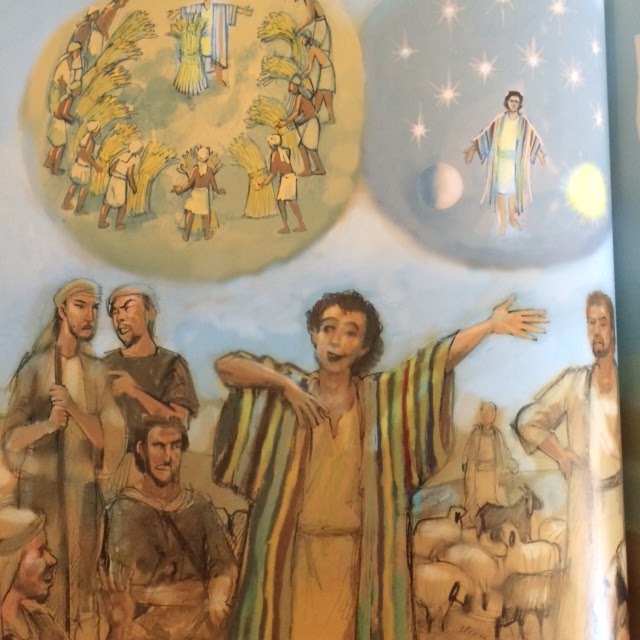
Jacob settled where his fathers once stayed, in the land of Canaan. These are the generations of Jacob: Joseph, his son, when he was 17 years old, was a shepherd with his brothers; but he was a young boy. And Joseph would bring wicked reports about his brothers to their father Jacob. Israel loved Joseph more than all his sons since he had him when he was an old man and so he made him a fancy wool coat. His brothers saw that their father loved Joseph the best so they hated him; and they could not speak to them peacefully.

One time Joseph had a dream which he then told his brothers - and they hated him even more. He said to them: “Listen to my dream! We were all tying up bundles of wheat in the middle of the field when, all of a sudden, my bundle stood up and then your bundles gathered around and started bowing down to my bundle.” His brothers said to him: “Are you going to be king over us? Are you going to be in control of us?” And they hated Joseph even more - because of his dreams and because of the way he talked.

Joseph had another dream and told it to his brothers. He said, “Hey, I had another dream! In my dream the sun, moon and eleven stars were bowing down to me!” And he also told the dream to his father. His father scolded him, saying, “What is this dream?! Are we - I, your mother, and your brothers - supposed to bow down to you?” So his brothers were jealous of him but his father kept the matter in his mind.

One day Joseph’s brothers went to Shekhem to put their father’s sheep out to graze. And Israel said to Joseph: “Your brothers are taking the sheep to graze in Shechem, aren’t they? Come on, I am going to send you to them.” Joseph said, “Here I am!” And he said to him, “Go now, see how your brothers and the sheep are doing and then come back to tell me.” So he sent him from Hevron and Joseph arrived in Shechem. [Note: this is 60 miles away]

A man found Joseph wandering around in the field. The man asked, “What are you looking for?” He said, “I’m looking for my brothers. Can you please tell me where they are letting the sheep graze?” The man said, “They’ve moved on from here. I overheard them saying they would go to Dothan.” So Joseph went after his brothers and found them in Dothan. [Note: this is about a day’s hike away.]

His brothers saw Joseph from a distance. When he had not yet reached them, they decided to kill him. They said to each other, “Look, the dreamer is coming! Let’s kill him and throw him into a pit - and we will say that a wild beast ate him. Then we’ll see if his dreams come true!”

Reuben, the oldest son, heard what they said and rescued Joseph from their hands. He said, “We will not kill him. Do not shed any blood! Instead, throw him into this pit here in the wilderness - but do not hurt him!” He hoped to rescue Joseph and return him to his father.

And so when Joseph came to his brothers, they stripped off his special coat and took him and threw him into the pit. The pit was empty and had no water in it.

The brothers sat down to eat. They looked up and saw a group of Ishmaelites coming from Gilead; their camels were carrying spices and they were on their way to bring them down to sell in Egypt. Judah said to his brothers, “What’s the point of killing our brother and then covering up his blood? Let’s sell him to these Ishmaelites. We won’t hurt him because he is our brother, our own flesh.” His brothers agreed. Midianite en who were traders were passing by. They lifted Joseph out of the pit and sold Joseph to the Ishmaelites for 20 pieces of silver - and those men brought Joseph to Egypt.

Reuben went back to the pit and saw that Joseph was gone! He tore his clothes [a sign of mourning]. He went back to his brothers and said, “The boy is gone! Where can I go?” They took Joseph’s coat, slaughtered a baby lamb and dipped the coat in the lamb’s blood. They brought the coat to their father and said, “Is this your son’s coat?” He recognized it and said, “My son’s coat! A beast devoured him! Joseph must have been torn to bits!” Then Jacob tore his clothes; he mourned for his son for so many days. All of his children tried to make him feel better but he would not let himself feel better, saying, “I will go to my grave mourning my son.” Joseph’s father cried and cried for him.

At this point the Midianites had sold Joseph in Egypt, to Potiphar, one of Pharaoh’s officials in charge of the butchers.  

Steps For Completing this Torah Hangout
When appropriate, follow this level key:  All / 2nd-3rd graders / 4th-6th graders

1. Read the story above slowly and carefully. Watch this video.

2. Either on a sheet of paper or with a partner, discuss the following questions:

  • Was it right for Jacob to favor Joseph? What could he have done differently as a father?
  • Was it right for Joseph to tell his father and brothers his dreams? What could he have done differently as a son and brother?
  • Was it right for Joseph’s brothers to hate him? What could they have done differently as sons and brothers?

3. Read the following commentaries and answer the related questions:

When the text says …. Rashi tells us it means …..

he was a young boy - He behaved childishly, fixing his hair and touching up his eyes so that he would appear handsome.
> According to this description, how would you describe Joseph’s personality? How does his personality affect the way you judge him, his brothers and his father?

His father scolded him - because he was bringing hatred upon himself.
> Why else might Jacob scold Joseph?

4. Share your response to one of the questions above on the blog.